
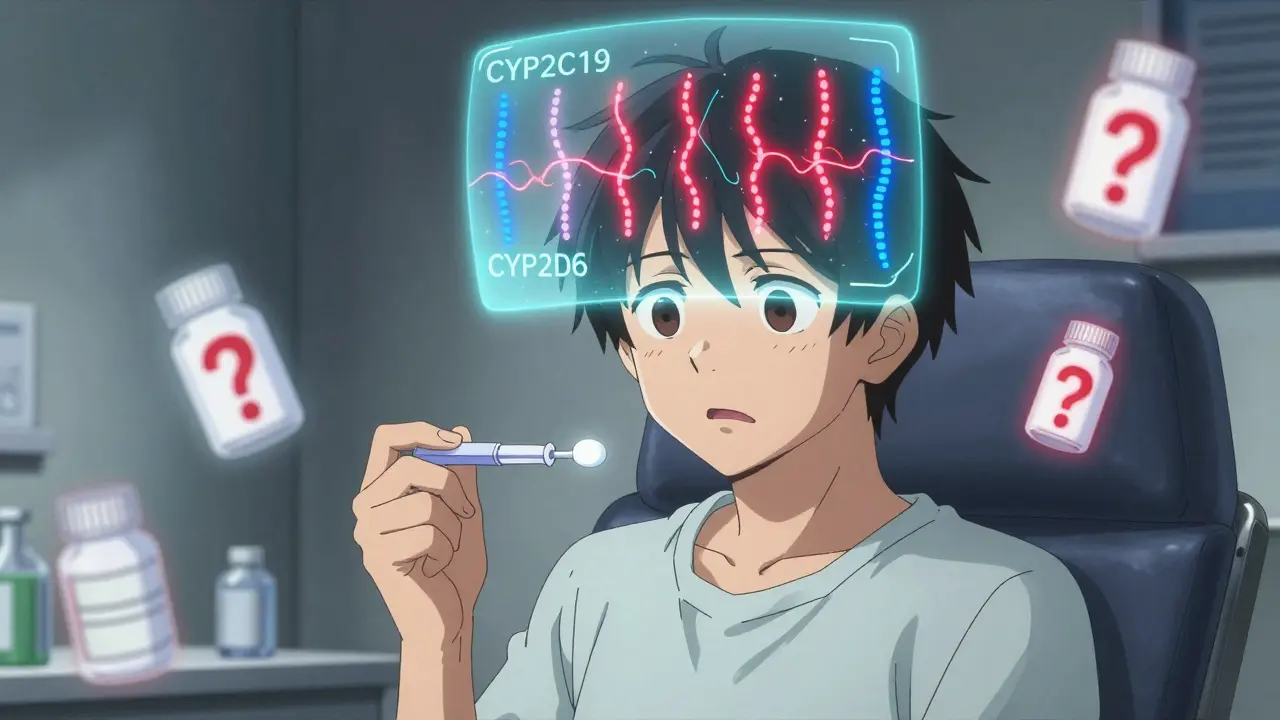
SSRI Metabolism Calculator
This tool helps you understand how your genetic makeup might affect your response to SSRIs. Based on your CYP2C19 and CYP2D6 metabolizer status, it shows potential drug levels, side effect risks, and dosing recommendations.
Your Personalized Results
Drug Levels & Side Effect Risk
Recommended Dosing
Key Information
Choosing the right SSRI shouldn’t feel like guessing. You take the pill, but instead of feeling better, you’re dizzy, nauseous, or wide awake at 3 a.m. This isn’t just bad luck-it might be your genes.
For years, doctors treated depression with a one-size-fits-all approach. Start with sertraline or escitalopram, wait six weeks, and if it doesn’t work, try another. But for nearly half of all patients, this trial-and-error method leads to side effects that are worse than the depression itself. That’s where pharmacogenomic testing comes in. Specifically, testing for two genes: CYP2C19 and CYP2D6. These aren’t just technical terms-they’re the reason some people react badly to antidepressants while others don’t.
What CYP2C19 and CYP2D6 Do to Your Antidepressants
Your body doesn’t process drugs the same way it processes food. It uses enzymes-tiny protein machines-to break down medications so they can be cleared from your system. Two of the most important enzymes for SSRIs come from the CYP2C19 and CYP2D6 genes. These enzymes are like factory workers on an assembly line: some are slow, some are fast, and some don’t show up at all.
CYP2C19 handles citalopram (Celexa), escitalopram (Lexapro), and sertraline (Zoloft). CYP2D6 processes fluoxetine (Prozac), paroxetine (Paxil), and venlafaxine (Effexor). If your version of these genes makes the enzyme work too slowly, the drug builds up in your blood. Too fast, and it gets cleared before it can help. This isn’t theoretical-it’s measurable.
Studies show that people with a CYP2C19 poor metabolizer genotype have 2.3 to 3.5 times higher levels of escitalopram in their blood than normal metabolizers. That’s not a small difference. It’s enough to cause headaches, sweating, heart palpitations, or even serotonin syndrome in extreme cases. On the flip side, ultrarapid metabolizers clear the drug so quickly that they never reach a therapeutic level-even at standard doses.
How Your Genes Change Your Side Effect Risk
It’s not about whether the drug works-it’s about whether you can tolerate it.
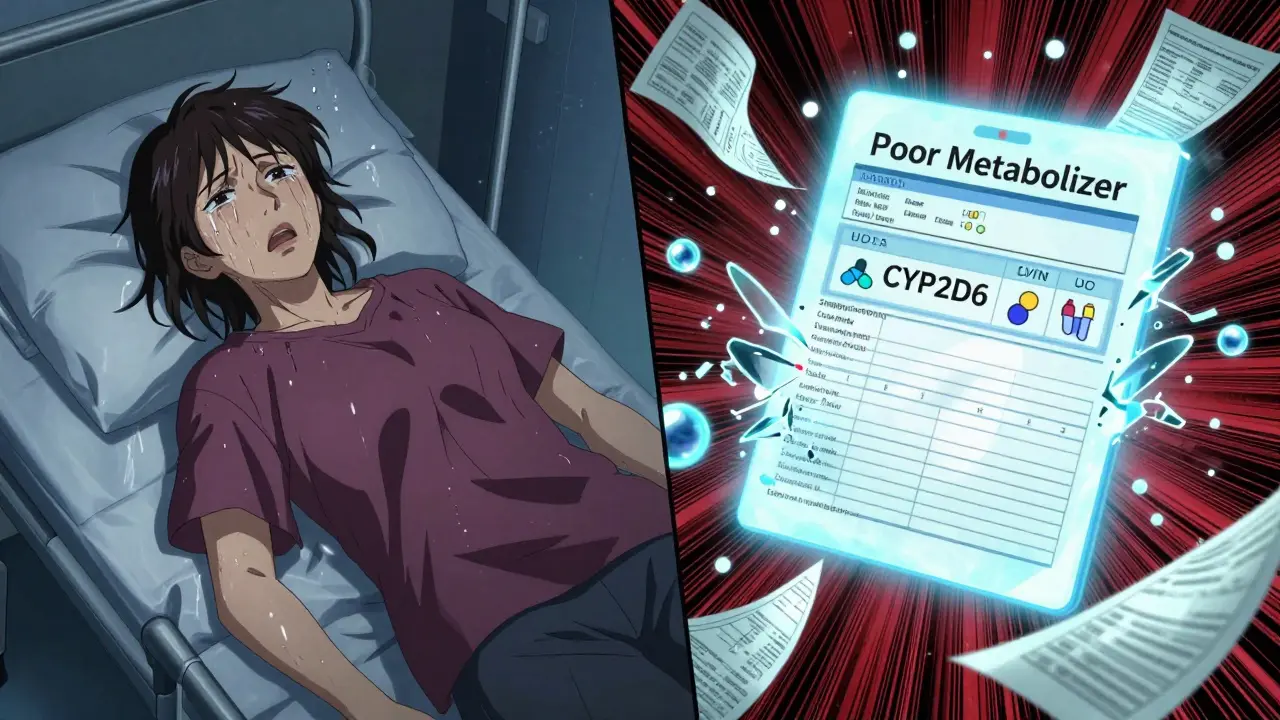
A 2023 study tracking over 5,800 patients found that CYP2D6 poor metabolizers were 2.7 times more likely to experience severe side effects from venlafaxine. Another study showed CYP2D6 poor metabolizers were 3.2 times more likely to report severe side effects from paroxetine. One 45-year-old woman in a clinical case series was prescribed 75 mg of venlafaxine-a common starting dose-and ended up in the ER with dizziness and insomnia. Her test revealed she was a CYP2D6 poor metabolizer. Reducing her dose to 37.5 mg eliminated the side effects and finally allowed her to feel better.
Conversely, a 32-year-old man tried escitalopram at 20 mg daily for eight weeks with no improvement. His genetic test showed he was a CYP2C19 ultrarapid metabolizer. His body was clearing the drug too fast. When his dose was doubled to 40 mg, his depression lifted within three weeks.
These aren’t rare outliers. About 30% of people have a CYP2C19 or CYP2D6 variant that changes how they process SSRIs. For some, it’s mild. For others, it’s the difference between healing and hospitalization.
Why Testing Isn’t Always a Magic Bullet
Here’s the catch: genes don’t tell the whole story.
While CYP2C19 and CYP2D6 clearly affect drug levels, they don’t always predict whether you’ll respond to treatment. A large 2024 study found no strong link between CYP2C19 genotype and improvement in depression symptoms-even though drug levels changed dramatically. That means two people with the same gene type might have totally different outcomes. Why? Because depression isn’t just about chemistry. It’s about stress, sleep, trauma, inflammation, and other genes too.
The Clinical Pharmacogenetics Implementation Consortium (CPIC) gives CYP2D6 and SSRIs a “Level B” evidence rating-meaning the data is promising but not as strong as for tricyclic antidepressants. For those, the link is clear enough to change dosing guidelines. For SSRIs, it’s still evolving.
Dr. Pedro Ruiz from the University of Miami puts it bluntly: “Pharmacogenetic testing gives you part of the picture. But you still have to listen to the patient.”
Who Should Get Tested-and When
You don’t need to be tested before your first antidepressant. But if you’ve tried two or more SSRIs and either had bad side effects or no improvement, testing makes sense.
Here’s who benefits most:
- People who had severe side effects (nausea, dizziness, insomnia, tremors) on an SSRI
- Those who didn’t respond to multiple antidepressants
- Patients taking multiple medications that interact with CYP2D6 or CYP2C19
- People with a family history of bad reactions to antidepressants
The test itself is simple: a cheek swab or blood sample. Results come back in 1-3 weeks. The accuracy is over 95% for detecting the main variants. But not all tests are equal. Some commercial panels miss rare or structural variants, especially with CYP2D6, which has complex gene duplications and deletions. The best tests use targeted sequencing, not broad genome scans.
Cost, Coverage, and Real-World Barriers
Testing costs between $250 and $600 out of pocket in the U.S. Insurance coverage is spotty-only 62% of major insurers cover it for antidepressants as of 2024. Medicare and Medicaid rarely pay for it unless you’ve failed multiple treatments.
But here’s the surprising part: even with upfront costs, testing can save money. A 2022 analysis found that using pharmacogenomic testing to guide antidepressant selection saved $1,200-$1,800 per patient by reducing failed trials, ER visits, and hospitalizations.
Doctors need training too. Most weren’t taught this in medical school. The American Psychiatric Association offers a 6-hour continuing education course on interpreting results. But many still don’t know how to read a pharmacogenomic report. That’s why working with a pharmacist certified in pharmacogenetics-there are about 1,200 in the U.S.-can make all the difference.

The Future: Beyond Two Genes
The April 2023 CPIC guidelines expanded beyond CYP2D6 and CYP2C19. Now they include CYP2B6, SLC6A4 (the serotonin transporter gene), and HTR2A (a serotonin receptor gene). These add more layers to the puzzle.
Researchers are now building polygenic risk scores-combining dozens of genetic markers with clinical data like age, weight, and other medications-to predict response more accurately. The NIH is funding a $15.2 million trial called GUIDED-2, testing this approach in 5,000 patients with treatment-resistant depression.
By 2026, some major hospitals plan to offer personalized SSRI selection based on full genetic profiles-not just two genes. But for now, CYP2C19 and CYP2D6 remain the most actionable.
What to Do Next
If you’ve struggled with SSRIs, ask your doctor about pharmacogenomic testing. Don’t wait until you’ve tried five drugs. If you’ve had side effects or no improvement after one or two, it’s worth exploring.
Use the free CPIC dosing guidelines online to understand what your results mean. Bring them to your appointment. If your doctor isn’t familiar, ask for a referral to a psychiatric pharmacist. You’re not asking for a miracle. You’re asking for a smarter way to get better.
Depression is complex. But your body’s reaction to medication doesn’t have to be a mystery. Your genes have been telling you what’s wrong. You just needed to listen.
Is pharmacogenomic testing for SSRIs worth it?
Yes-if you’ve had side effects or no improvement with one or more SSRIs. Testing can prevent dangerous drug buildup or identify if you’re clearing the medication too fast. For people who’ve tried multiple antidepressants without success, it often cuts months off the trial-and-error process. Studies show it can save $1,200-$1,800 per person by reducing failed treatments and ER visits.
Do all SSRIs use CYP2C19 and CYP2D6?
No. CYP2C19 mainly handles citalopram, escitalopram, and sertraline. CYP2D6 handles fluoxetine, paroxetine, and venlafaxine. Fluvoxamine uses both. Other SSRIs like mirtazapine or bupropion aren’t primarily metabolized by these enzymes. Always check which enzyme your specific medication uses before testing.
Can I get tested without a doctor?
Some direct-to-consumer companies offer pharmacogenetic tests, but they’re not always clinically validated. Results from these tests may not be interpreted correctly for antidepressant use. For reliable, actionable results, get tested through a medical provider or psychiatric clinic that uses CLIA-certified labs and follows CPIC guidelines.
Does insurance cover pharmacogenomic testing for antidepressants?
Coverage is inconsistent. As of 2024, only 62% of major U.S. insurers cover it, usually only after you’ve tried at least two antidepressants without success. Medicare and Medicaid rarely cover it. Check with your insurer first. Some labs offer payment plans or reduced pricing if you pay out of pocket.
How long does it take to get results?
Typically 1 to 3 weeks from the time your sample is collected. Some labs offer expedited processing for $100-$200 extra. Results include your metabolizer status for CYP2C19 and CYP2D6-poor, intermediate, normal, rapid, or ultrarapid-and specific dosing recommendations based on CPIC guidelines.
Can I stop my SSRI while waiting for test results?
No. Never stop an antidepressant abruptly. Even if you’re having side effects, talk to your doctor first. Stopping suddenly can cause withdrawal symptoms like brain zaps, anxiety, or flu-like feelings. Your doctor may adjust your dose temporarily while waiting for results, but don’t make changes on your own.
Are there any risks to pharmacogenomic testing?
The test itself is low-risk-a simple swab or blood draw. The bigger risk is misinterpreting results. A poor metabolizer result doesn’t mean you can’t take the drug-it means you need a lower dose. An ultrarapid metabolizer doesn’t mean the drug won’t work-it means you might need a higher dose. Always have results reviewed by someone trained in pharmacogenomics, like a psychiatric pharmacist.
Pharmacogenomic testing won’t fix depression overnight. But it removes the guesswork from one of the most frustrating parts of treatment: finding a medication your body can handle. For too long, patients were told to just “try harder.” Now, science gives us a better way.





Lance Nickie
January 13, 2026 AT 15:14