
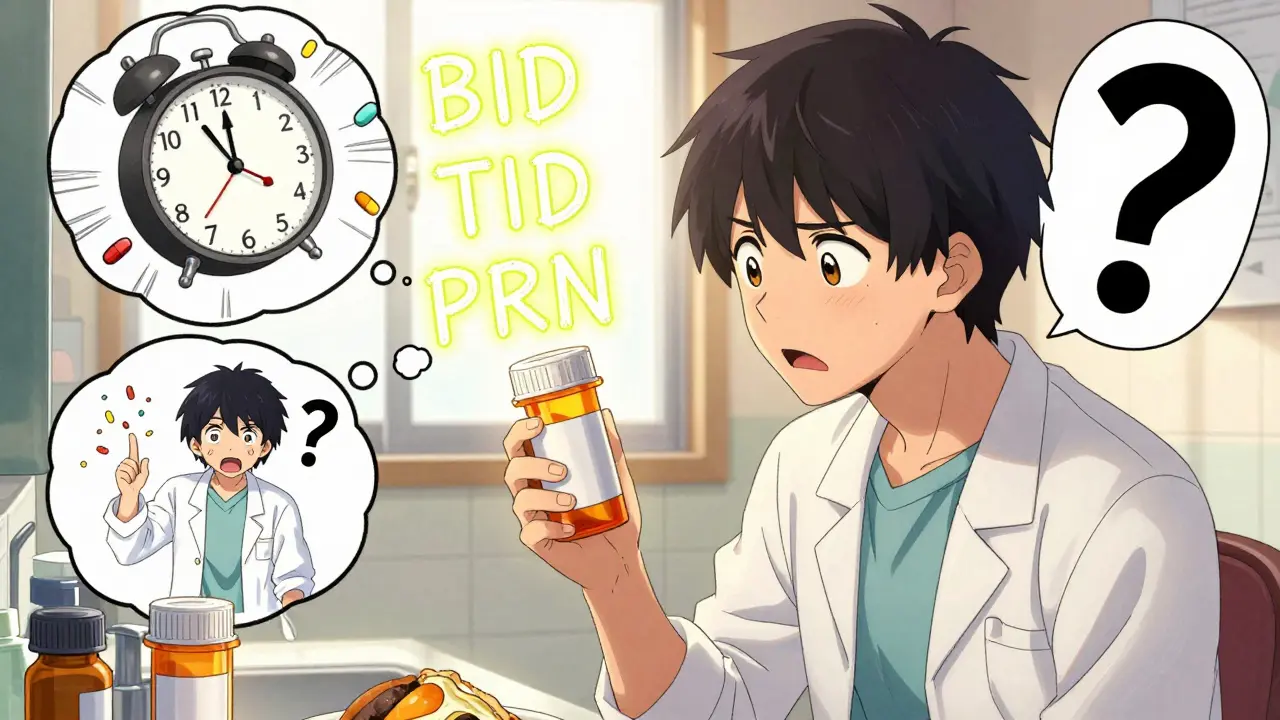
Ever stared at your prescription label and wondered what BID, TID, or PRN actually means? You’re not alone. Millions of people in the U.S. take medications every day, but nearly 7 out of 10 say they don’t fully understand the abbreviations on their labels. That confusion isn’t just frustrating-it can be dangerous. A missed dose, an extra pill, or taking medicine at the wrong time can reduce effectiveness, cause side effects, or even lead to hospitalization.
What BID, TID, and PRN Really Mean
These aren’t random letters. They’re Latin abbreviations that doctors and pharmacists have used for over a century to save space on handwritten prescriptions. Today, even with electronic systems, they’re still everywhere. Here’s what they actually mean:- BID = bis in die - twice a day
- TID = ter in die - three times a day
- PRN = pro re nata - as needed
Timing Matters More Than You Think
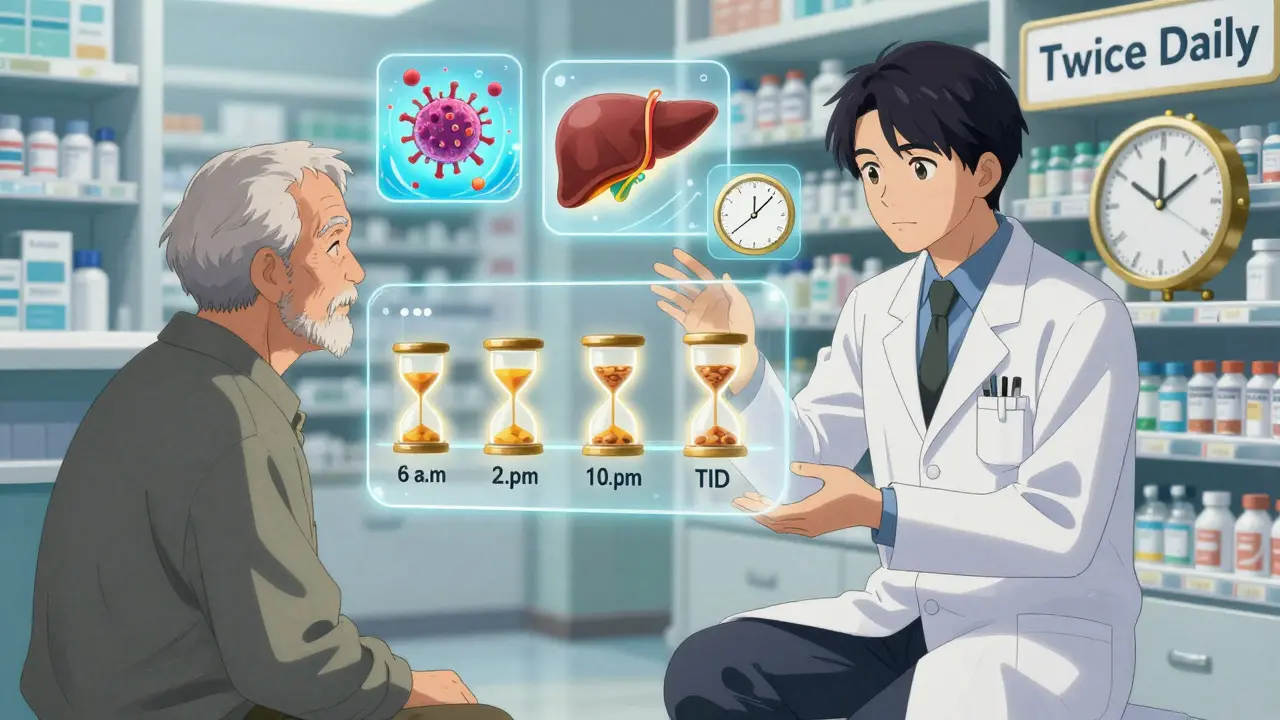
For some medications, timing isn’t just a suggestion-it’s critical. Take antibiotics, for example. If your prescription says TID, you’re supposed to space the doses about 8 hours apart: say, 6 a.m., 2 p.m., and 10 p.m. That keeps a steady level of the drug in your bloodstream to kill bacteria effectively. A 2021 study from Johns Hopkins found that when people took TID antibiotics with uneven spacing-like 8 a.m. and 8 p.m., skipping the middle dose-the treatment was 27% less effective. That means your infection might not clear up, or worse, the bacteria could become resistant. Same goes for BID. It’s not “morning and night.” It’s roughly 12 hours apart. So if you take your first dose at 7 a.m., the next should be around 7 p.m. Not 8 a.m. and 8 p.m. on a 16-hour gap.PRN Isn’t a Free Pass
PRN is one of the most misunderstood terms. It means “as needed,” but that doesn’t mean “whenever you feel like it.” Every PRN prescription comes with rules:- What symptom it treats (e.g., pain, nausea, anxiety)
- How much you can take at once
- How often you can take it in a day (e.g., “max 3 doses in 24 hours”)
- How long to wait between doses (e.g., “every 6 hours”)
Other Common Abbreviations You’ll See
Here’s a quick cheat sheet for other abbreviations you might find on your label:- QD = once daily (not “every day at the same time”-but try to be consistent)
- QID = four times a day (every 6 hours)
- Q4H = every 4 hours (even overnight, unless otherwise instructed)
- AC = before meals (usually 30-60 minutes before)
- PC = after meals (within 30 minutes)
- HS = at bedtime
- PO = by mouth (oral)
Why These Abbreviations Still Exist
You’d think by 2025, we’d have ditched Latin terms for plain English. And in many places, we have. The U.S. Pharmacopeia (USP) has been pushing to eliminate them since 2023, with a hard deadline of December 31, 2025. Kaiser Permanente and other large health systems already switched to plain language-and saw a 29% drop in patient calls asking for clarification. But change is slow. About 68% of U.S. prescriptions still use these abbreviations, according to the FDA. Why? Because many doctors still learned them in medical school. Some pharmacists still print them out of habit. And not every pharmacy system automatically converts them. A 2024 study in the New England Journal of Medicine found that doctors over 50-who make up nearly 40% of U.S. physicians-are far less likely to switch to plain English, even when their hospital says to.How to Protect Yourself
You don’t have to guess. Here’s how to make sure you’re taking your medicine right:- Ask the pharmacist-not just once, but every time you pick up a new prescription. Pharmacists are trained to explain this stuff. In fact, 89% of patients say they felt more confident after a pharmacist walked them through it.
- Ask for plain English. Say: “Can you write this out in words?” Most chain pharmacies (CVS, Walgreens, Walmart) now offer this on the label or on a separate sheet. Independent pharmacies? Less likely. Push for it.
- Use a pill organizer. Buy one with time slots labeled “Morning,” “Afternoon,” “Evening,” “Bedtime.” It removes guesswork.
- Download a medication app. Apps like Medisafe, MyTherapy, or DoseSpot convert BID/TID/PRN into real-time reminders with alarms. They even tell you if you’re taking doses too close together.
- Use the teach-back method. After the pharmacist explains, say: “So, just to make sure I got it right-you’re saying I take this twice a day, 12 hours apart, with food, and I can’t take more than two pills in 24 hours?” If you can say it back correctly, you’re good.
- Do a brown bag review. Once a year, bring all your meds-bottles, pills, patches-to your doctor or pharmacist. They’ll spot duplicates, overlaps, or confusing instructions you might have missed.
What Happens When You Get It Wrong
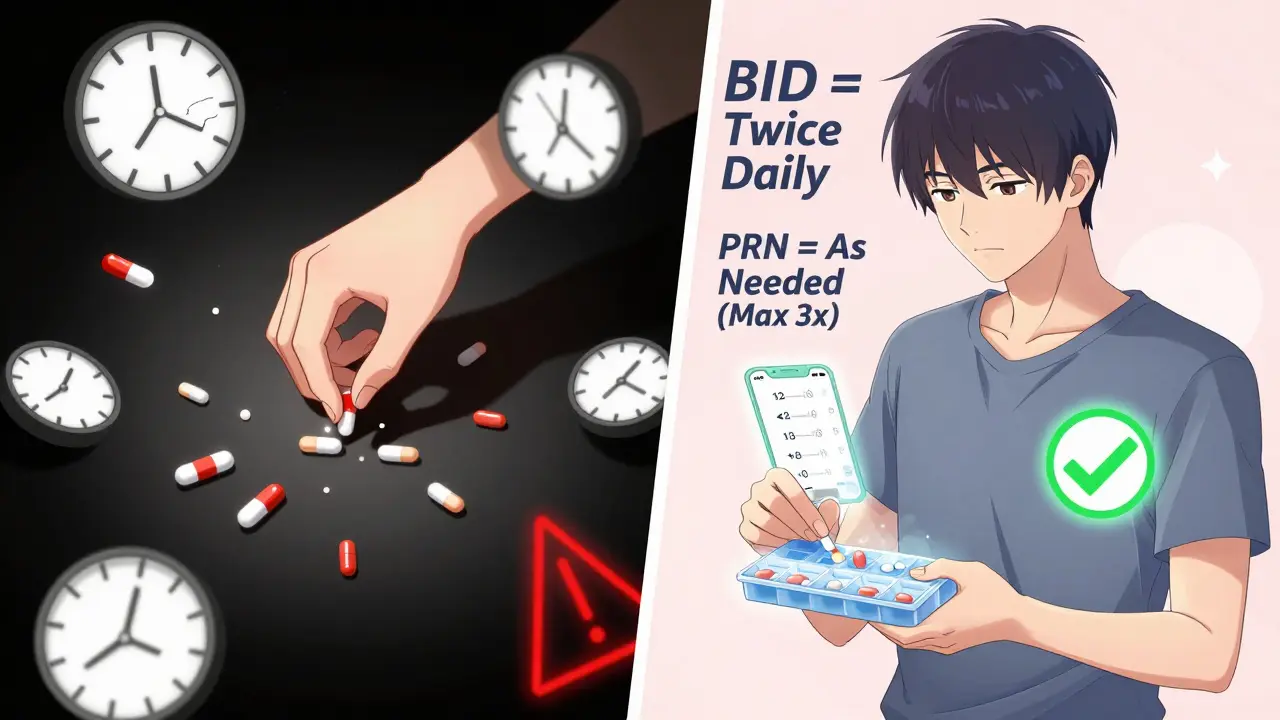
Misreading a prescription isn’t just a mistake-it’s a safety risk. Between 2015 and 2019, over 1,200 medication errors in the U.S. were directly tied to misinterpreting abbreviations. One case involved a patient who took insulin labeled “U” (for units), but the “U” looked like a “0.” She gave herself 10 times the dose. She ended up in the ER. Another patient thought TID meant “three days,” so she took her antibiotic only once a day for a week. Her infection got worse. She needed hospitalization. Even small errors add up. A 2022 Milken Institute report found that medication non-adherence-often caused by confusion-costs the U.S. healthcare system $318 billion a year. That’s more than the entire budget of the Department of Education.The Future Is Plain English
The writing’s on the wall. By 2027, most experts predict Latin abbreviations will be nearly gone in the U.S. The Joint Commission, FDA, and USP are all pushing for plain language. Some countries, like the UK, already banned them in 2015. Now, prescriptions say “twice daily,” not “b.i.d.” The shift isn’t just about safety-it’s about fairness. Older adults, non-native English speakers, and people with low health literacy are hit hardest by these abbreviations. A 2023 Kaiser Family Foundation survey found that 42% of adults over 65 misread BID as “before and after dinner.” That’s not a small error. That’s a risk to their life.Bottom Line: Don’t Guess. Ask.
Your health isn’t a puzzle to solve. If you see BID, TID, or PRN on your label, don’t assume. Don’t Google it. Don’t ask your neighbor. Go straight to the person who filled your prescription: the pharmacist. They’re paid to help you understand this stuff. And they’ve heard it all before. The best tip from real patients? “If you can’t read it or don’t understand it, ask.” That’s not just advice-it’s your right. And in a world where medicine is getting more complex, knowing how to read your label might be the most important skill you never learned in school.What does BID mean on a prescription?
BID stands for "bis in die," which is Latin for "twice a day." It means you should take the medication two times in a 24-hour period, ideally about 12 hours apart-like 8 a.m. and 8 p.m. It does not mean "before and after dinner," unless your doctor or pharmacist specifically says so.
Is TID the same as every 8 hours?
Yes, TID (ter in die) means three times a day, and the standard recommendation is to space doses about 8 hours apart-for example, 6 a.m., 2 p.m., and 10 p.m. This keeps a steady level of the drug in your system. If you take doses too far apart (like only morning and night), the medicine may not work as well, especially with antibiotics or heart medications.
Can I take PRN medicine whenever I want?
No. PRN means "as needed," but it always comes with limits. Check the label for how much you can take at once, how often (e.g., every 4-6 hours), and the maximum number of doses allowed in 24 hours. Taking too much PRN medicine-like ibuprofen or acetaminophen-can cause serious harm, including liver or kidney damage.
Why do pharmacies still use Latin abbreviations?
Many doctors still use them out of habit, and some electronic prescribing systems automatically include them. Even though the FDA and USP have pushed to eliminate them, full replacement won’t be complete until 2026. About 68% of prescriptions still contain Latin abbreviations, especially in handwritten or older systems.
What should I do if I don’t understand my prescription label?
Call or visit your pharmacy and ask the pharmacist to explain it in plain English. You can also ask for a printed handout with simple instructions. Never guess. If you’re unsure, it’s better to wait and ask than to risk taking the wrong dose. Pharmacists expect these questions-and they’re trained to help.
Are there apps that help me understand my prescriptions?
Yes. Apps like Medisafe, MyTherapy, and DoseSpot convert abbreviations like BID and PRN into clear reminders with alarms. They also track your doses, warn you if you’re taking too much, and let you share your schedule with family members. Many are free and work with your phone’s calendar.






Dominic Suyo
December 18, 2025 AT 21:53