Why drug shortages keep happening - and how to stop them
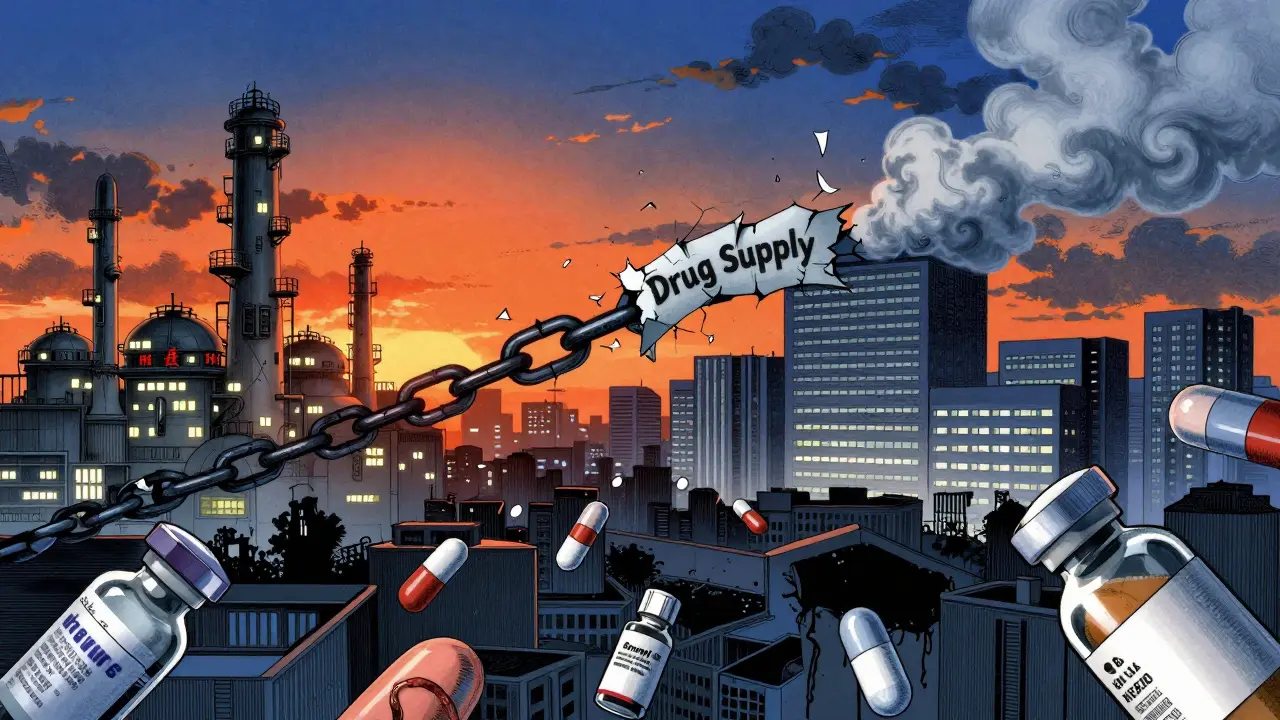
Every year, hospitals face unexpected drug shortages. Cancer treatments run out. Antibiotics disappear. Insulin stocks drop. These aren’t accidents. They’re the result of supply chains built for speed, not safety. When a factory in China shuts down for a week, or a shipment gets stuck at a port, patients pay the price. The system was designed to cut costs, not prevent crises. Now, with global tensions and manufacturing bottlenecks growing, fixing this isn’t optional - it’s life-or-death.
Where your medicine really comes from
Most people think their pills are made in the U.S. They’re not. About 80% of the active ingredients in American drugs come from overseas, mostly from China and India. In fact, 68% of all active pharmaceutical ingredients (APIs) are produced in just those two countries. That’s not just a supply chain - it’s a single point of failure. One weather event, one political dispute, one factory fire, and entire classes of medicines vanish. Sterile injectables? Only 12% are made domestically. Antibiotics? Just 17%. The rest rely on overseas facilities with no backup.
What resilience really means - not just stockpiling
Resilience isn’t about hoarding drugs in warehouses. It’s about designing systems that don’t break when something goes wrong. The U.S. Department of Health and Human Services defines it clearly: the ability to anticipate, prepare for, respond to, and recover from disruptions - while still delivering medicine. That means three things: being ready before a crisis hits, keeping things running during it, and bouncing back fast after. It’s not magic. It’s strategy.

Three proven ways to build resilience
- Dual-sourcing: Don’t rely on one supplier. Top companies now get 70-80% of their critical ingredients from at least two different locations - one in Asia, one in Europe or North America. This cuts the risk of total failure by more than half.
- Buffer stock: Keep 60-90 days of inventory for essential medicines like insulin, heparin, and chemotherapy drugs. That’s not excess - it’s insurance. Companies doing this saw 23% higher continuity during disruptions.
- Regional manufacturing networks: Instead of one global factory, build smaller, flexible production hubs in North America, Europe, and Southeast Asia. This way, if one region goes dark, another can pick up the load.
The tech revolution no one’s talking about
Old-school batch manufacturing - making drugs in big vats over weeks - is slow, wasteful, and expensive. Newer continuous manufacturing systems run 24/7 in compact, modular units. They use 30-40% less space, cut energy use by 20-25%, and reduce waste by 15-20%. Even better: AI tools now predict quality issues before they happen, improving yield rates by 18-22%. One company reduced defects by 30% just by using real-time data from sensors on their production line. The catch? These systems cost $50-150 million to set up. That’s why only 12 have been approved by the FDA so far - out of over 10,000 traditional ones.
Government action - and its limits
In August 2025, the U.S. government launched the Strategic Active Pharmaceutical Ingredients Reserve. The goal? Store enough of 150 critical drugs to cover 90 days of demand by 2027. That’s a start. But you can’t stockpile everything. There are over 1,000 essential medicines. The real solution? Incentivizing domestic production. The CHIPS and Science Act already poured $1.2 billion into manufacturing infrastructure. Another $800 million was proposed in 2025. But experts warn: trying to make everything in the U.S. is unrealistic. It would raise prices by 20-30% and create new vulnerabilities. The smart move? Build strategic capacity here - for the drugs we can’t afford to lose - while keeping global partnerships for the rest.

What’s holding companies back?
Most big pharmaceutical firms know they need to act. But 78% say internal silos block progress. Finance wants cost cuts. Supply chain wants safety. Legal wants compliance. IT can’t connect systems. Without leadership pushing alignment, nothing changes. The companies that win? They have executives directly overseeing resilience. They spend 5-10% of their supply chain budget on it. They use integrated platforms that track every supplier - all 12-15 tiers deep. One medtech company cut decision time during a crisis by 60% just by giving one team full access to real-time data.
The cost of doing nothing
Building resilience costs money. Estimates say it adds 8-12% to the cost of goods sold. But the alternative? A single disruption can cost large companies $14.7 million in lost revenue - not counting patient harm. And it’s not just about profits. The Department of Defense calls drug supply chain failures a “critical national security risk.” Imagine a military deployment without antibiotics. Or a hospital during a pandemic without ventilator sedatives. The price isn’t just financial. It’s human.
What’s next? The road to 2030
By 2030, 65-70% of U.S. drug supply will come from regional networks, not global single sources. Domestic production will rise to 35-40%. AI will predict disruptions 60-90 days ahead with 85-90% accuracy. Blockchain will cut counterfeit drugs by 70-75%. But we’re not there yet. Workforce shortages loom - 250,000 skilled manufacturing jobs will go unfilled by 2027. Regulatory standards still don’t match across countries. And the global investment needed? $120-150 billion. The path forward isn’t about choosing between “made in America” or “made abroad.” It’s about smart diversification: secure the essentials here, partner globally for the rest, and use technology to make every step more predictable.
What are the biggest causes of drug shortages?
The top causes are overseas manufacturing dependence (especially in China and India), single-source suppliers, aging infrastructure, regulatory delays, and natural disasters or geopolitical events that disrupt shipping or production. A single factory shutdown can cut supply of a critical drug by 100% if no alternatives exist.
Can the U.S. make all its drugs domestically?
No, and trying to do so would be costly and inefficient. The U.S. currently produces only 28% of essential medicine APIs. Building full domestic capacity for all drugs would raise prices by 20-30% and create new risks - like over-reliance on one domestic facility. The smarter approach is to secure domestic production for the most critical drugs - like sterile injectables and life-saving antibiotics - while maintaining diversified global sourcing for others.
How much inventory should hospitals keep on hand?
For essential medicines - like insulin, heparin, epinephrine, and chemotherapy agents - experts recommend maintaining 60-90 days of inventory. This buffer gives time to reroute supply or activate backup sources during disruptions. Smaller hospitals often keep only 10-14 days, leaving them vulnerable. Larger systems with better forecasting can reduce this to 45 days with AI-driven demand modeling.
What role does AI play in preventing shortages?
AI analyzes global data - weather, political events, shipping delays, factory output, and even social media trends - to predict disruptions 60-90 days in advance with 85-90% accuracy. It also optimizes production schedules, reduces quality defects by 25-30%, and identifies hidden risks in supplier networks. Companies using AI report faster responses and fewer stockouts.
Are continuous manufacturing systems worth the investment?
Yes - if you’re producing high-demand, low-margin drugs like antibiotics or generics. Continuous manufacturing cuts production time from weeks to hours, reduces waste by 15-20%, and lowers energy use by 20-25%. The upfront cost is high ($50-150 million), but ROI comes in 3-5 years through efficiency gains and reduced recalls. For high-value biologics, traditional methods still dominate, but for mass-produced generics, this is the future.
How do regulatory hurdles slow progress?
The FDA has approved only 12 continuous manufacturing facilities since 2004, compared to over 10,000 batch systems. Approval for new tech takes 2-3 years - too long for urgent innovation. In 2025, the FDA shortened approval timelines to 12-18 months for qualified facilities, but companies still face inconsistent global standards. Harmonizing regulations across the U.S., EU, and WHO would cut development time by 40%.