
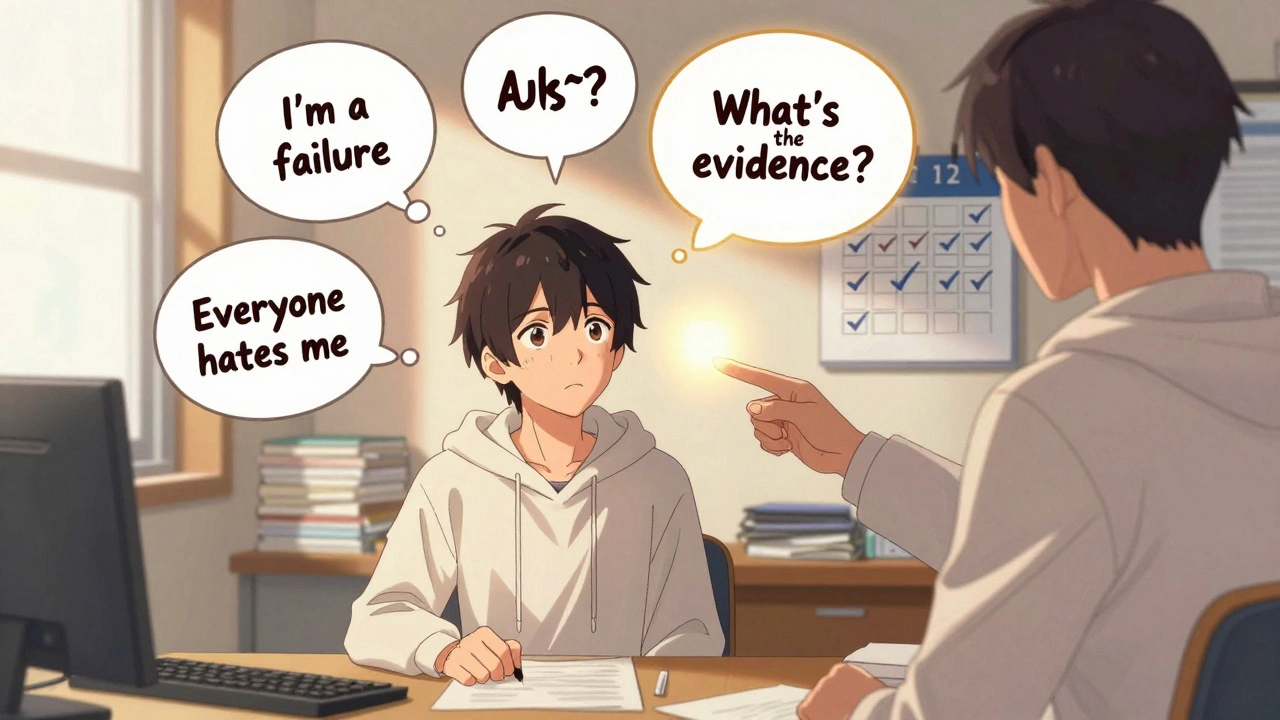
When you're stuck in a loop of negative thoughts-worrying about what people think, replaying past mistakes, or dreading the future-it’s not just "feeling down." It’s your mind running on faulty software. Cognitive-behavioral therapy (CBT) is the most tested, most trusted psychological treatment for fixing that software. Unlike talk therapy that digs into childhood, CBT focuses on what’s happening right now: your thoughts, your actions, and how they feed each other. And it works-fast.
How CBT Actually Works
CBT doesn’t pretend your pain is imaginary. It says: your thoughts shape your feelings, and your feelings shape your behavior. If you think, "I’m going to fail this presentation," your heart races, your hands shake, and you avoid preparing. That’s a cycle. CBT breaks it by teaching you to spot those distorted thoughts and replace them with ones that match reality.
It’s not about being positive. It’s about being accurate. Instead of "I’m a failure," you learn to ask: "What’s the evidence for that? What’s another way to look at this?" You don’t just talk about it-you practice. You keep a thought record. You test beliefs through small experiments. You face fears step by step. That’s why it’s called behavioral therapy too.
Therapists use tools like the 5-Part Model: Situation → Thoughts → Emotions → Behaviors → Physical Sensations. If you feel panic before a social event, you trace it back. Was it the thought, "Everyone will judge me"? Or the belief, "I have to be perfect to be liked"? Once you see the link, you can change it.
What Conditions Does CBT Treat?
CBT isn’t a one-size-fits-all fix, but it’s been proven effective for a long list of common problems. The National Institute for Health and Care Excellence (NICE) in the UK, one of the strictest guideline bodies in the world, recommends CBT as a first-line treatment for:
- Depression
- Anxiety disorders (including social anxiety, panic disorder, generalized anxiety)
- Post-Traumatic Stress Disorder (PTSD)
- Obsessive-Compulsive Disorder (OCD)
- Eating disorders like bulimia
- Insomnia
- Chronic pain
- Substance use disorders
For depression, studies show 60-80% of people see major improvement after 12-16 sessions. For OCD, a specific CBT technique called Exposure and Response Prevention (ERP) leads to full symptom remission in many cases. For anxiety, CBT outperforms medication in long-term results-people are less likely to relapse after stopping treatment.
Why It Beats Other Therapies
There are hundreds of therapies out there. So why does CBT lead the pack?
Over 2,000 randomized controlled trials have been done on CBT since the 1970s-more than any other psychological treatment. A major 2012 meta-analysis reviewed 269 studies and found CBT had stronger effects than other therapies for anxiety and depression. In the NIMH’s STAR*D trial, CBT matched antidepressants in reducing depression symptoms-but had half the relapse rate after a year.
It’s also faster. Psychodynamic therapy might take years. CBT usually takes 8 to 20 weekly sessions. You leave with tools, not just insights. You don’t just feel better-you learn how to stay better.
And it’s adaptable. CBT has been successfully used in over 37 countries, with cultural adaptations for different values and communication styles. In Australia, Canada, the UK, and the US, it’s the most common therapy offered through public health systems like the NHS and Medicare.
What It Doesn’t Do Well
CBT isn’t magic. It has limits.
It’s not the best choice for people with severe cognitive impairment, active psychosis, or those who can’t focus enough to do homework. If trauma is deeply rooted and the person feels unsafe, therapies like EMDR or Dialectical Behavior Therapy (DBT) often work better-especially for borderline personality disorder, where DBT shows 30% higher success rates.
It also doesn’t focus much on personality patterns or deep emotional wounds from childhood. Some critics say it treats symptoms, not the person. But newer versions of CBT-called "third-wave" therapies-like Acceptance and Commitment Therapy (ACT) and Mindfulness-Based Cognitive Therapy (MBCT) now include those elements. ACT, for example, helps people accept painful thoughts instead of fighting them, which works better for chronic pain and emotional avoidance.
What Happens in a Session?
CBT isn’t sitting on a couch talking about your mom. It’s structured, active, and collaborative.
Each session lasts 45-60 minutes. You and your therapist set an agenda. You review last week’s homework. You learn a new skill. You practice it in session. Then you get new homework.
Homework is key. It might be:
- Writing down three negative thoughts and finding evidence against them
- Going to a coffee shop for 10 minutes to practice sitting with anxiety
- Tracking your sleep patterns to identify triggers for insomnia
- Gradually facing a fear-like making a phone call, then texting, then speaking up in a meeting
It sounds simple. But doing it? That’s where the change happens. Most people who drop out of CBT say it’s because the homework felt too hard. But therapists know that. They use motivational techniques to help you stick with it.
Who Can Deliver CBT?
Not every therapist is trained in CBT. To be certified, therapists typically need:
- 120-180 hours of specialized training
- Supervision on at least 20 real cases
- Passing a formal exam (like the one from the Academy of Cognitive Therapy)
In Australia, many psychologists, social workers, and counselors have this training. Look for "CBT-certified" or "evidence-based practitioner" on their website. Public clinics like Headspace or private providers listed through the Australian Psychological Society’s directory often specialize in CBT.
There’s also digital CBT-apps like Woebot (FDA-cleared in 2021) or This Way Up, which offer structured CBT modules. Studies show they work, especially for mild to moderate anxiety and depression. But they’re not as effective as in-person therapy for complex cases. Think of them as a helpful supplement, not a replacement.
Real People, Real Results
People don’t just say CBT "helps." They say it changed their lives.
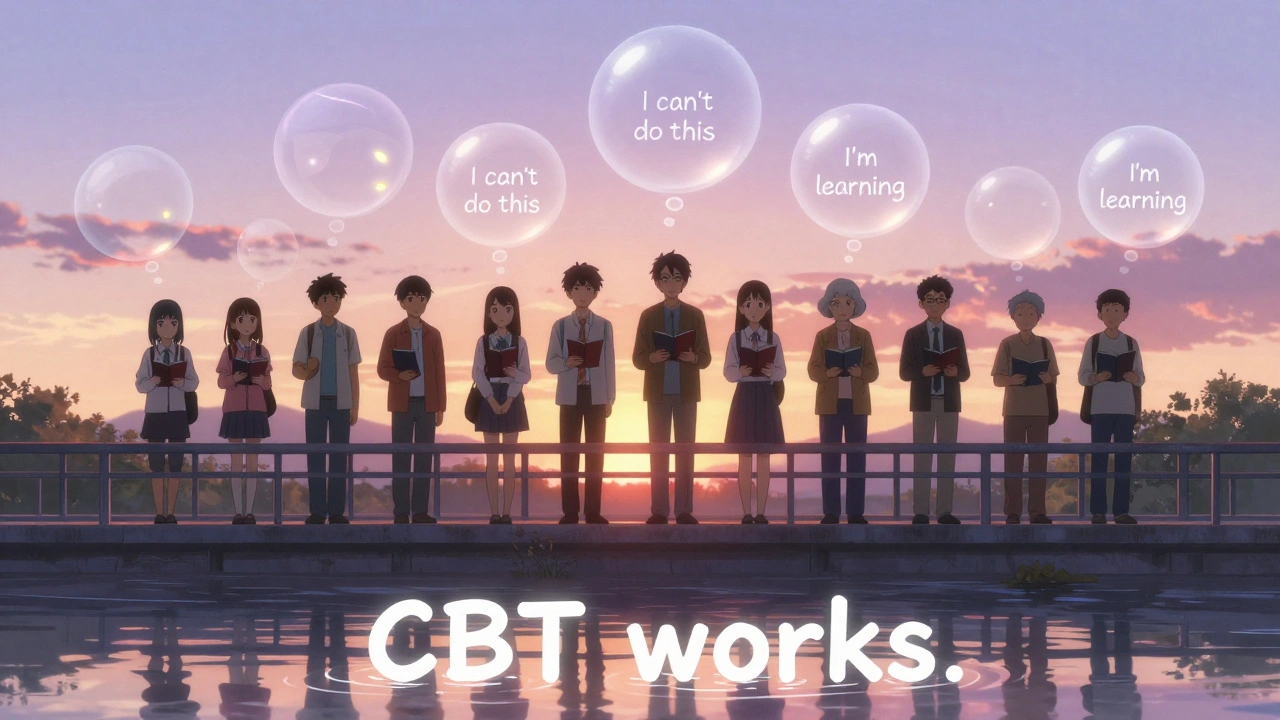
One woman in Brisbane, who had panic attacks 15 times a week, started CBT for social anxiety. After 12 sessions of graded exposure-starting with saying "hi" to a neighbor, then asking a question at a store, then attending a small gathering-her panic attacks dropped to two per week. She now leads a weekly book club.
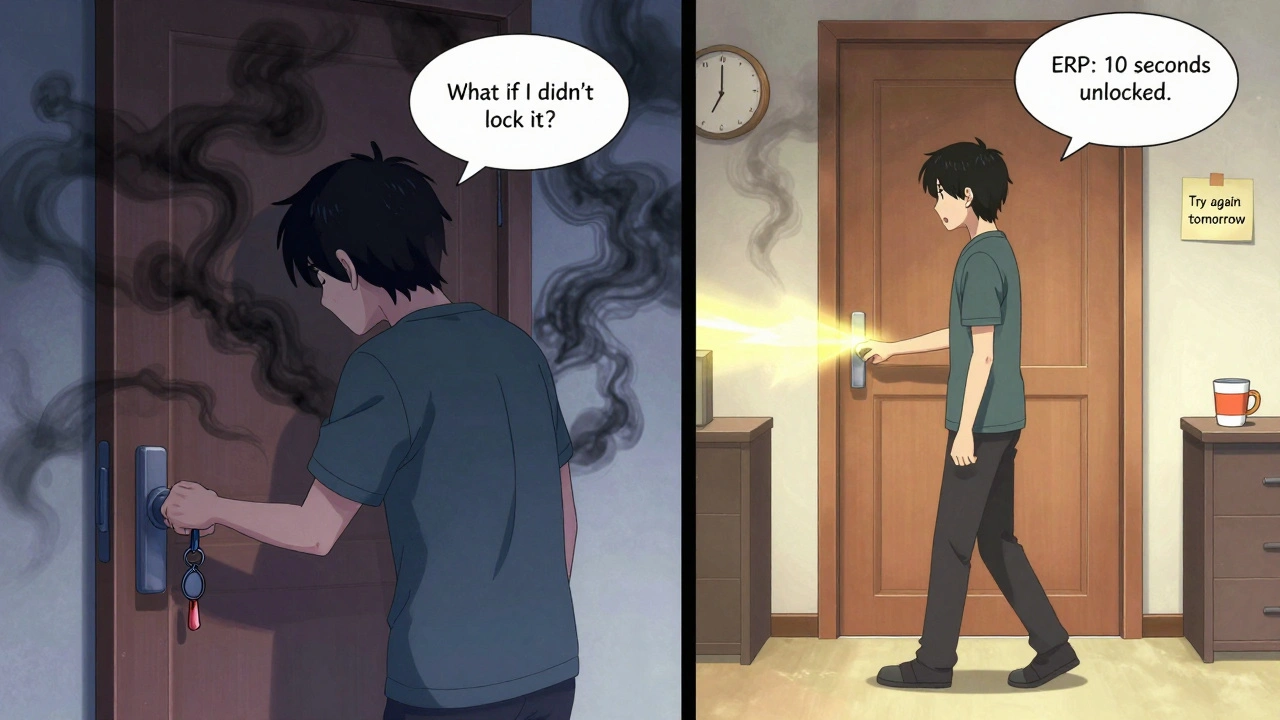
A man with OCD spent hours checking his locks and washing his hands. Through ERP, he slowly stopped checking. First, he left the door unlocked for 10 seconds. Then a minute. Then an hour. After 18 sessions, he stopped checking altogether. He went back to work full-time.
On Reddit and Psychology Today, 87% of users rate CBT as "very effective" or "extremely effective" for anxiety. The most praised tools? Thought records and behavioral experiments.
How to Get Started
If you think CBT might help:
- Check with your GP. In Australia, you can get a Mental Health Treatment Plan for up to 20 subsidized sessions per year through Medicare.
- Search the Australian Psychological Society’s "Find a Psychologist" tool and filter for "CBT" or "evidence-based."
- Call clinics and ask: "Do you use CBT? Are you certified?"
- Try a free CBT workbook from NAMI or the Beck Institute-many are available online.
- Start small. Even one session can help you understand if it’s the right fit.
It’s not about being "broken." It’s about learning a better way to think. And that’s something anyone can do-with the right tools.
What’s Next for CBT?
CBT isn’t standing still. Researchers are now using AI to analyze thought records in real time, helping therapists spot patterns faster. The National Institute of Mental Health is testing "precision CBT"-matching treatment techniques to brain activity patterns. In five to seven years, we may see CBT programs tailored to your biology, not just your symptoms.
But the core hasn’t changed. CBT works because it gives people power. Not over their past. Not over their emotions. But over their thoughts. And that’s the most valuable thing therapy can offer.
Is CBT just about thinking positive thoughts?
No. CBT isn’t about forcing yourself to be optimistic. It’s about replacing distorted, unhelpful thoughts with ones that are more accurate and balanced. For example, instead of thinking, "I’ll never get better," you might learn to say, "I’m having a hard time right now, but I’ve improved before, and I can use these tools to help again." It’s about truth, not cheerleading.
How long does CBT take to work?
Most people start seeing changes within 4-6 weeks. For anxiety or depression, significant improvement often happens by session 12. Some conditions, like OCD or PTSD, may take longer-up to 20 sessions. The key is consistency. Doing homework between sessions speeds up progress dramatically.
Can I do CBT on my own without a therapist?
Yes, for mild to moderate issues, self-guided CBT using books, apps, or online programs can be very effective. Tools like This Way Up or the Beck Institute’s free workbooks are evidence-based. But if you’re struggling with severe symptoms, trauma, or have tried self-help before without success, working with a trained therapist gives you support, feedback, and accountability-things apps can’t replace.
Does CBT work for children and teens?
Absolutely. CBT is one of the most effective treatments for childhood anxiety, OCD, and depression. For younger kids, therapists use games, drawings, and stories to teach skills. For teens, it’s often adapted to fit their world-social media pressure, school stress, peer rejection. Studies show 60-70% of teens show major improvement after 12-16 sessions.
What if I don’t like my CBT therapist?
It’s okay to switch. CBT relies on trust and collaboration. If your therapist is dismissive, doesn’t give you homework, or ignores your concerns, it won’t work. Don’t stay with someone who doesn’t feel like a good fit. Ask for referrals. Try someone else. The technique matters, but the relationship matters just as much.
Is CBT covered by insurance in Australia?
Yes. Through Medicare, you can get up to 20 subsidized sessions per calendar year with a Mental Health Treatment Plan from your GP. Many private health insurers also cover CBT under their extras policies. Always check your policy or call your provider to confirm.
Does CBT help with physical health problems?
Yes. Chronic pain, insomnia, and even some digestive issues like IBS are strongly linked to stress and thought patterns. CBT helps people manage the emotional and behavioral side of these conditions. For example, learning to reduce catastrophizing thoughts about pain can lower perceived intensity and improve daily function. It’s not a cure-but it’s a powerful tool for living better with long-term health issues.
If you’re tired of feeling trapped by your own mind, CBT gives you a way out-not by changing the world, but by changing how you see it. And that’s a change you can control.






Reshma Sinha
December 13, 2025 AT 07:13