
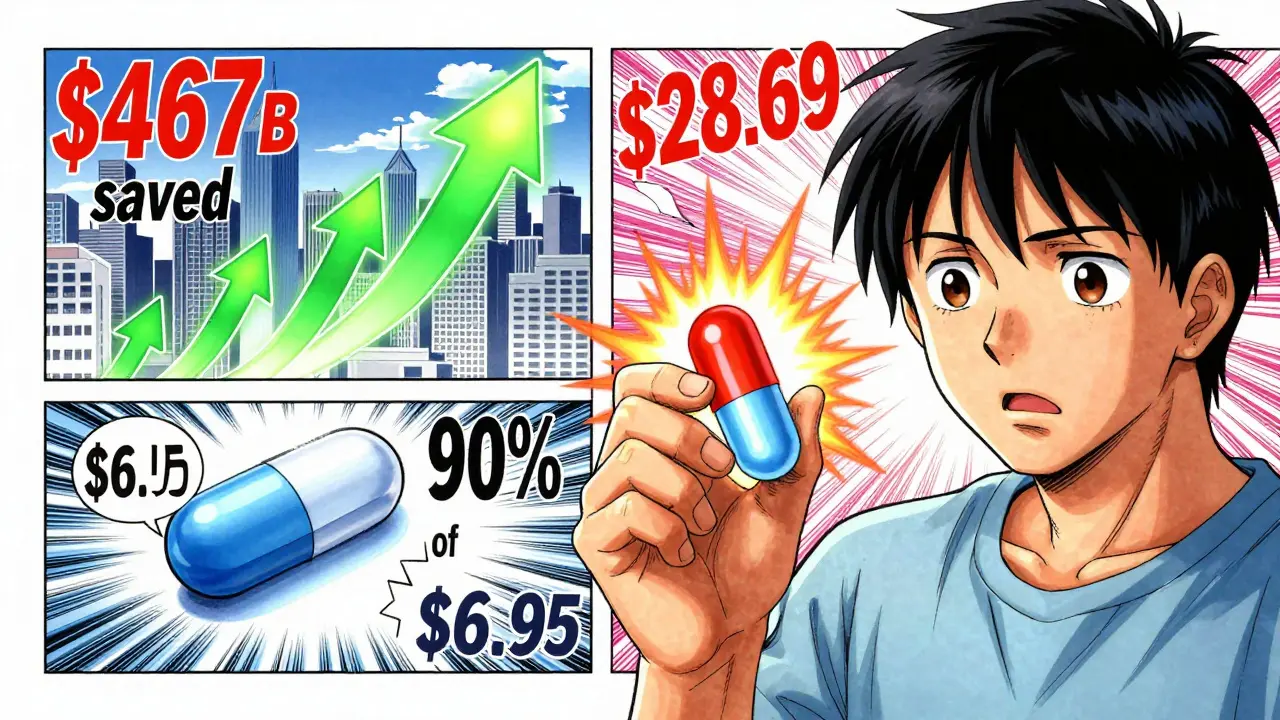
Every year, Americans spend over $700 billion on prescription drugs. But here’s the twist: 90% of the prescriptions filled are generics - and they cost just 12% of that total. That’s not a typo. In 2024, generic and biosimilar drugs saved the U.S. healthcare system $467 billion. That’s more than the entire annual budget of the Department of Education. And over the last decade, those savings have added up to more than $3.4 trillion.
How Much Do Generics Actually Save You at the Pharmacy?
If you’ve ever compared the price of a brand-name pill to its generic version, you know the difference is stark. In 2024, the average out-of-pocket cost for a generic prescription was $6.95. For a brand-name drug? $28.69. That’s nearly five times more. For people without insurance, the gap widens even more. Brand-name drugs cost an average of $130.18 per prescription - up 50% since 2019. Meanwhile, generic prices dropped by 6% over the same period. You’re not imagining things. Generics really are getting cheaper, even as brand-name drugs keep rising.The Numbers Behind the Market Share
In 2024, Americans filled 3.9 billion generic prescriptions. That’s 90% of all prescriptions written. Brand-name drugs? Just 435 million - 10% of the total. But here’s where it gets wild: those 10% of prescriptions accounted for 88% of all drug spending. Meanwhile, the 90% generic share made up only 12% of spending. It’s the ultimate cost-efficiency story. Generics aren’t just popular - they’re the reason prescription drug costs haven’t exploded even faster.Biosimilars Are the New Powerhouse
Biosimilars - generic versions of complex biologic drugs - are making their mark fast. In 2024 alone, they saved $20.2 billion, nearly doubling from the year before. Since they entered the market in 2015, biosimilars have saved the system $56.2 billion. And half of those savings came in just the last two years. These drugs treat conditions like rheumatoid arthritis, cancer, and diabetes - conditions that used to cost tens of thousands per year. Now, biosimilars bring those costs down by 20% to 40%. No drop in effectiveness. No new side effects. Just massive savings.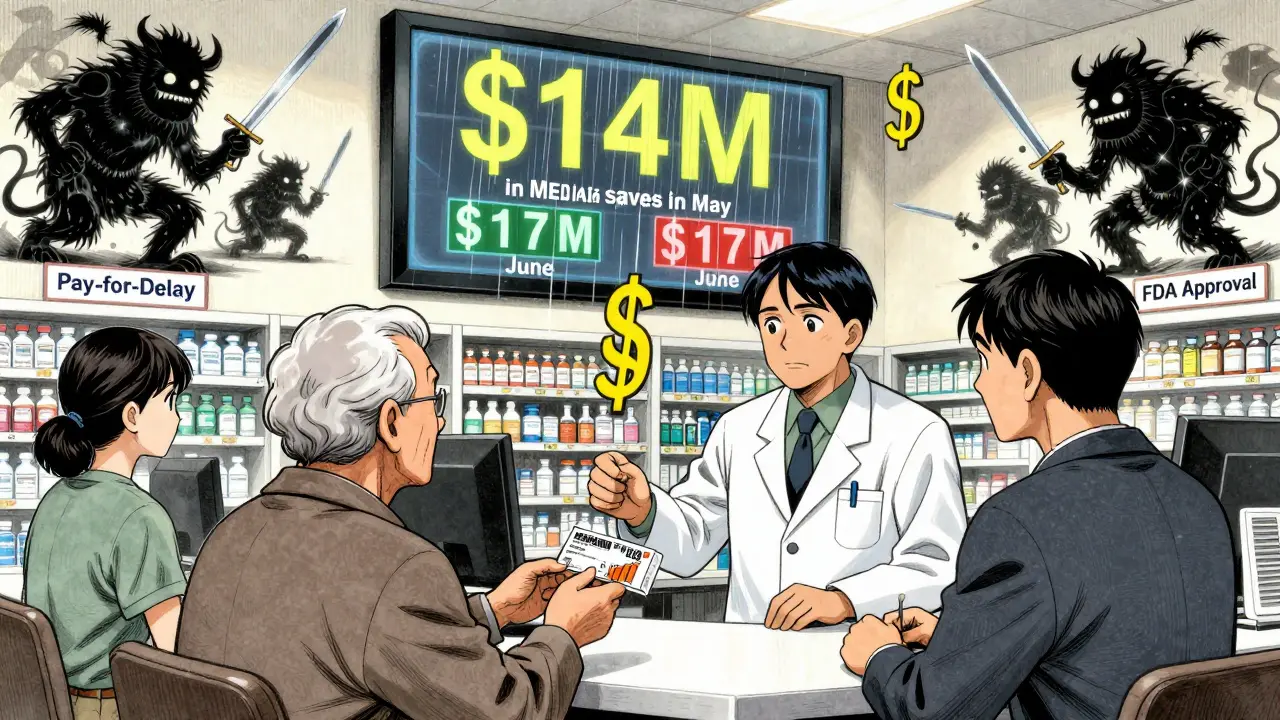
Why Are Generics Getting Cheaper Even as More Are Sold?
This is the most counterintuitive part: since 2019, total spending on generic drugs has dropped by $6.4 billion - even though more prescriptions are being filled. In 2015, Americans used about 167 billion generic pills. By 2024, that number hit 197 billion. More people, more pills, less money spent. That’s not normal in any other industry. It’s called price deflation, and it’s unique to generics. Why? Because when one company starts making a generic, others follow. Competition drives prices down - sometimes to pennies per pill. In April to July 2025, generic drugs caused $14 million in net price drops for Medicaid in May, and $17 million in June. Meanwhile, brand-name drugs were still rising.The Dark Side: Why Generics Might Disappear
There’s a problem no one talks about enough: generic manufacturers are being squeezed to death. When a drug’s patent expires, dozens of companies jump in. Prices crash. Profit margins shrink. Some companies can’t survive. And when a company goes under, the drug can disappear from shelves - even if it’s the only treatment for a condition. The Biosimilars Council warns that the price deflation of the last 30 years is now threatening patient access. In 2025, shortages of generic antibiotics, heart medications, and anesthesia drugs spiked. One drug, Vasostrict, saw its list price drop 76% in just three months - a win for patients, but a death sentence for the manufacturer. If no one can make money making generics, no one will make them.Brand-Name Drug Price Hikes Are Still Happening
While generics keep falling, big pharma keeps raising prices. In January 2025, the top pharmaceutical companies hiked prices on 250 brand-name drugs by a median of 4.5%. That’s nearly double the overall inflation rate. Some drugs jumped over 10%. Meanwhile, generics are still falling. This creates a dangerous imbalance. Patients who need expensive brand-name drugs - like insulin or cancer treatments - are stuck paying more. But even those patients benefit indirectly. Without generics keeping overall drug spending in check, insurance premiums and Medicare costs would be even higher.
What’s Blocking Even More Savings?
The system isn’t broken - it’s being manipulated. Pay-for-delay deals, where brand-name companies pay generic makers to delay launching cheaper versions, cost the system $12 billion a year. Banning them could save $45 billion over 10 years. Then there’s “product hopping” - when a company slightly changes a drug just before its patent expires, then files a new patent. That delays generics for years. The Congressional Budget Office says stopping these practices could save $2.9 billion over a decade. And PBMs (pharmacy benefit managers) often don’t pass savings to patients, even when generics are cheaper. Medicare, which paid $142 billion less in 2024 thanks to generics, still has rules that block access to the cheapest options.What This Means for You
If you’re paying for prescriptions, always ask for the generic. It’s not a compromise - it’s the same medicine, approved by the FDA, and tested to work just as well. For chronic conditions like high blood pressure, diabetes, or depression, switching to a generic can save you hundreds - even thousands - per year. If your doctor says a brand-name is “necessary,” ask why. Most of the time, it’s not. And if you’re on Medicare, check your plan’s formulary. The lowest-cost option is often the generic - but your plan might not list it as preferred unless you ask.The Bigger Picture: Generics Are the Unsung Hero of Healthcare
Generics and biosimilars make up just 1.2% of total U.S. healthcare spending. But they’re responsible for saving hundreds of billions in drug costs. Without them, the system would collapse under its own weight. They’re the reason millions of people can afford their meds. They’re the reason drug prices haven’t skyrocketed even faster. But they’re also the most vulnerable part of the system. If policymakers don’t fix patent abuse, stop pay-for-delay deals, and protect generic manufacturers from unsustainable pricing, the savings will vanish - and so will the drugs.Are generic drugs really as effective as brand-name drugs?
Yes. The FDA requires generic drugs to have the same active ingredients, strength, dosage form, and route of administration as the brand-name version. They must also meet the same strict standards for quality, purity, and performance. Bioequivalence studies prove they work the same way in the body. Over 90% of prescriptions filled in the U.S. are generics - and they’re used safely by tens of millions of patients every day.
Why are generic drugs so much cheaper?
Generic manufacturers don’t have to repeat expensive clinical trials. They only need to prove their version works the same as the original. That cuts development costs dramatically. Plus, when multiple companies make the same generic, competition drives prices down - sometimes to just a few cents per pill. Brand-name companies, on the other hand, recoup R&D costs through high prices during their patent monopoly.
Can I trust generic drugs if they look different?
Absolutely. The shape, color, or packaging of a generic drug doesn’t affect how it works. Those differences are due to trademark laws - generic makers can’t copy the brand’s appearance. But the active ingredient, dosage, and effectiveness are identical. If you’re concerned, ask your pharmacist to confirm the generic matches the brand in active ingredients.
Why do some generic drugs have shortages?
Shortages happen when manufacturers can’t make enough profit to keep producing a drug. Low prices, low margins, and high production costs make some generics unprofitable. If one company stops making a drug and no one else steps in, it disappears. This is especially common with older, low-cost generics used for critical conditions like heart failure or seizures. It’s a systemic issue - not a quality problem.
Do biosimilars work the same as biologic drugs?
Yes. Biosimilars are highly similar to their reference biologics, with no clinically meaningful differences in safety or effectiveness. They’re not exact copies - biologics are too complex - but they’re proven to work the same way in patients. Over 3.3 billion days of patient therapy have been completed with biosimilars since 2015, with no unique safety concerns reported.
How can I find out if a generic is available for my prescription?
Ask your pharmacist or doctor. You can also check the FDA’s Orange Book online or use your pharmacy’s app - most list generic alternatives and their prices. If your insurance requires prior authorization for a brand-name drug, you can often appeal by requesting the generic. Many insurers cover generics at lower copays or even $0.
Are generic drugs made in the same facilities as brand-name drugs?
Many are. The FDA inspects all manufacturing facilities - whether they make brand-name or generic drugs - and holds them to the same standards. In fact, about half of all generic drugs are made by companies that also produce brand-name versions. The difference isn’t where they’re made - it’s who pays for the research and how the market competes after the patent expires.



Stewart Smith
January 2, 2026 AT 08:04