

When a woman is pregnant or breastfeeding and needs psychiatric medication, the stakes are higher than ever. It’s not just about treating depression, anxiety, or bipolar disorder-it’s about protecting two lives at once. But here’s the hard truth: too many women fall through the cracks. One provider says to stay on medication; another says to stop. No one talks to the other. And by the time she realizes something’s wrong, it’s too late.
The good news? There’s a clear, evidence-based way to fix this. The American College of Obstetricians and Gynecologists (ACOG) laid out a detailed plan in 2023 that’s already changing outcomes. It’s not complicated. It’s not theoretical. It’s a five-step protocol backed by data from over 147 studies and real-world results from 8,742 pregnant women.
Why Coordination Isn’t Optional
Let’s start with numbers that can’t be ignored. Between 15% and 20% of women experience a mental health episode during pregnancy or in the first year after birth. Left untreated, severe depression raises the risk of preterm birth by 40% and low birth weight by 30%. On the other hand, some medications carry small but real risks-like a 0.5% increase in heart defects with sertraline, compared to a 1% baseline risk in the general population.
That’s not a reason to avoid medication. It’s a reason to get smart about it.
Studies show that when OB/GYNs and psychiatrists work together, medication discontinuation drops from 42% to just 18%. Postpartum depression symptoms fall by 37%. The difference isn’t luck-it’s structure.
Yet, 67% of providers say their electronic records don’t talk to each other. Insurance delays push psychiatric consults past two weeks. And in one case documented by Project TEACH NY, a woman stopped her sertraline after conflicting advice-then ended up hospitalized for severe postpartum depression. That’s the cost of poor coordination.
Who Does What? Clear Roles, No Overlap
Many OB/GYNs feel pressured to manage psychiatric meds alone. But here’s the reality: they handle 58% of perinatal depression cases, yet only initiate treatment in 12% of bipolar disorder cases. That’s not because they’re untrained-it’s because they’re not equipped to handle the full picture.
Psychiatrists bring expertise in drug interactions, dosing adjustments, and relapse triggers. OB/GYNs know how pregnancy changes your body-plasma volume increases by 40-50%, kidney filtration goes up by 50%, and liver enzymes like CYP450 can spike 40-60% in the third trimester. These changes alter how meds are absorbed, metabolized, and cleared.
So here’s the division:
- OB/GYN: Monitors pregnancy progress, checks for physical side effects, tracks fetal growth, manages prenatal labs, and initiates treatment for mild-to-moderate depression or anxiety.
- Psychiatrist: Determines optimal medication type and dose, manages complex cases (bipolar, psychosis, treatment-resistant depression), handles medication changes, and advises on long-term safety during breastfeeding.
Neither can do it alone. But together? They cover what neither could alone.
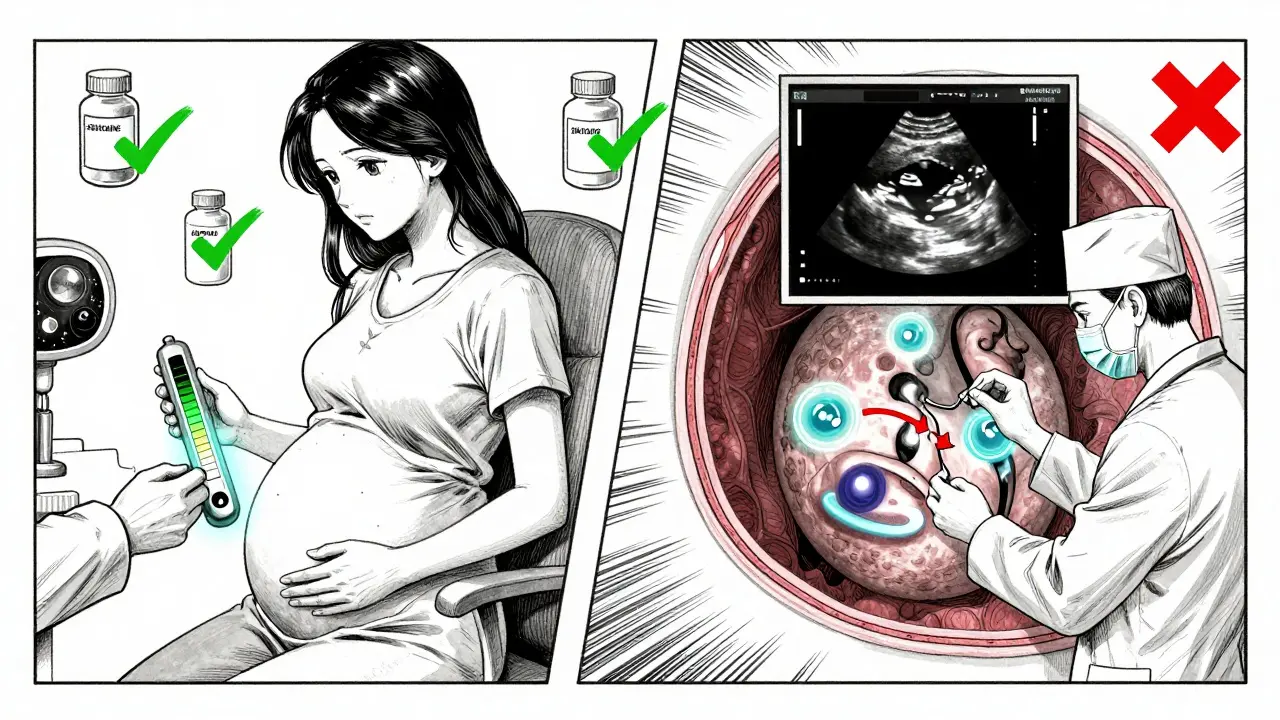
The Five-Step Coordination Protocol
ACOG’s 2023 guidelines aren’t suggestions-they’re a step-by-step roadmap. Here’s how it works in practice.
Step 1: Preconception Planning
This is the most overlooked step-and the most powerful.
If you’re trying to get pregnant and on psychiatric meds, schedule a joint consultation with your OB/GYN and psychiatrist before conception. Ideally, 3 to 6 months ahead. This isn’t about stopping meds. It’s about choosing the safest ones.
For example:
- First-line antidepressants: sertraline or escitalopram. Both have the lowest risk profile. Sertraline binds 98% to protein, crosses the placenta minimally, and has no active metabolites.
- Avoid: paroxetine (linked to higher heart defect risk) and valproate (10.7% risk of major birth defects).
- For bipolar disorder: Lithium is still an option if monitored closely. But valproate? Never.
Use the ACOG Reproductive Safety Checklist. It rates risks on a 1-10 scale-for both maternal relapse and fetal exposure. You’re not guessing. You’re deciding with data.
Step 2: First Joint Visit at 8-10 Weeks
By week 8, your body is already changing. Medication levels drop as blood volume expands. That’s why the first coordinated visit should happen now.
This isn’t a 10-minute chat. It’s a 45-minute session where both providers:
- Review current meds and doses
- Check lab values (like lithium levels if applicable)
- Update the risk-benefit calculation: “Without treatment, 65% chance of relapse. With sertraline 75mg, 0.5% increase in cardiac defects.”
- Set a communication plan: Who calls when? How often?
Documentation matters. Every decision should be recorded in both records. No more “I thought she was seeing someone else.”
Step 3: Ongoing Communication Every 4 Weeks
For stable patients, check-ins every 4 weeks. For acute cases-weekly.
Use a standardized template. It should include:
- Current dose and timing
- Protein binding percentage
- Placental transfer coefficient
- Lactation risk category (L1-L5)
- Any symptoms of relapse or side effects
For example: “Escitalopram 10mg daily-protein binding 97%, placental transfer low (ratio 0.2), lactation category L1 (safest). No maternal symptoms. Fetal growth on track.”
This isn’t bureaucracy. It’s safety.
Step 4: Breastfeeding Transition
Many women panic about breastfeeding while on meds. But here’s the truth: most SSRIs are safe.
According to the National Pregnancy Registry for Psychiatric Medications, over 15,000 pregnancies have been tracked. The data shows:
- Sertraline: Infant serum levels are 0.1-0.5% of maternal dose. No reported adverse effects.
- Escitalopram: Even lower transfer. Preferred for nursing mothers.
- Fluoxetine: Avoid. Long half-life. Builds up in infant.
Don’t stop meds to breastfeed. The risk of relapse is far greater than the risk of medication in breastmilk. ACOG strongly recommends continuing first-line SSRIs during lactation.
And if you’re worried? Use the LactMed database-free, evidence-based, and updated monthly by the NIH.
Step 5: Emergency Protocol
What if she’s having a panic attack at 28 weeks? Or her mania is escalating?
Have a plan. ACOG recommends:
- “Warm handoff”: OB/GYN calls psychiatrist directly while the patient is in the room. No voicemails. No delays.
- Telehealth video consults within 24 hours for urgent cases.
- For benzodiazepines: Only if absolutely necessary, and only for 7-10 days max. Weekly psychiatrist oversight required.
Delay kills. A 72-hour communication gap is the average in fragmented systems. That’s 3 days of untreated illness. That’s enough to spiral.

Barriers-and How to Break Them
It’s not all smooth sailing.
Insurance delays: 57% of privately insured women wait over 14 days for a psychiatric consult. Solution? Use telehealth. ACOG now approves asynchronous consults completed within 72 hours for stable patients.
Electronic records don’t talk: 67% of providers report incompatibility. Solution? Advocate for EHR integration. Epic Systems launched its Perinatal Mental Health Module in early 2023. It auto-alerts psychiatrists when an OB/GYN prescribes psychiatric meds. Over 1,200 U.S. hospitals now use it.
Provider stigma: Some OB/GYNs still think “psych meds aren’t my job.” But ACOG’s guidelines say: OB/GYNs are responsible for initiating treatment. You don’t need to be a psychiatrist. You just need to know when to call one.
And if you’re a patient? Bring the ACOG checklist. Ask: “Have we talked about this with my psychiatrist?” If the answer is no-push for it.
The Bigger Picture
This isn’t just about one pregnancy. It’s about breaking a cycle.
Women who get coordinated care are more likely to stay well after birth. Their babies are less likely to be preterm or underweight. Their next pregnancy? They’re more likely to plan it.
And the system is catching up. CMS now gives practices a 5% reimbursement bonus if they document psychiatrist-OB/GYN communication in 90% of perinatal cases. The FDA updated medication labels in 2024 to include coordination recommendations. NIH is launching a 5,000-woman trial in late 2024 using genetic testing to personalize med choices.
For too long, mental health during pregnancy was treated as a side issue. It’s not. It’s central. And coordinated care isn’t a luxury-it’s the standard.
Can I stay on antidepressants while breastfeeding?
Yes, most antidepressants are safe during breastfeeding. Sertraline and escitalopram are the top choices-they transfer minimally into breastmilk, with infant exposure under 0.5% of the mother’s dose. Studies show no increase in developmental delays, colic, or sleep issues. Fluoxetine should be avoided due to its long half-life. Always check the LactMed database from the NIH for the latest safety data.
What if my OB/GYN won’t refer me to a psychiatrist?
You have the right to ask for coordinated care. ACOG’s 2023 guidelines state that OB/GYNs must initiate treatment or refer when indicated. If your provider refuses, ask for a written reason. Then contact your insurance or a maternal-fetal medicine specialist. Many academic hospitals have dedicated perinatal psychiatry teams that accept direct referrals. You don’t need permission to advocate for your health.
Are mood stabilizers safe during pregnancy?
Lithium is generally safe with close monitoring-blood levels must be checked weekly in the third trimester. Valproate is strictly avoided-it carries a 10.7% risk of major birth defects. Lamotrigine is another option with a low risk profile, but doses may need adjustment due to increased clearance during pregnancy. Never stop mood stabilizers without psychiatric guidance. Untreated bipolar disorder poses greater risks to mother and baby than medication.
How do I know if my medication dose needs adjusting?
Pregnancy changes how your body processes meds. Plasma volume increases by 40-50%, and kidney filtration rises by 50%. This means many drugs are cleared faster. If you notice worsening symptoms, fatigue, or nausea, it may be a sign your dose is too low. Your OB/GYN and psychiatrist should monitor you every 4 weeks. Blood tests (for lithium, for example) and symptom tracking are key. Don’t wait until you’re in crisis to ask.
What if I’m already on medication when I find out I’m pregnant?
Don’t panic. Don’t stop cold turkey. Contact both your OB/GYN and psychiatrist immediately. Most medications-especially sertraline and escitalopram-can be continued safely. Abrupt discontinuation increases relapse risk by 70%. The goal isn’t to switch meds unless necessary. It’s to adjust safely. Use the ACOG Reproductive Safety Checklist to weigh risks. You’re not alone-this happens every day.