

Imagine waking up in the middle of the night feeling like your big toe is on fire, and even the weight of a bedsheet feels like a crushing blow. For millions of people, this isn't a nightmare-it's a gout flare. While most of us think of gout is a painful inflammatory arthritis caused by the accumulation of uric acid crystals in the joints as a "rich man's disease" involving too much steak and red wine, the reality is much more clinical. It is a breakdown in how your body processes purines, leading to a condition called hyperuricemia. If you're dealing with this, the goal isn't just to stop the current pain, but to change the chemistry of your blood to prevent the next attack.
The Science of Purines: Why Your Body Makes Uric Acid
To understand why gout happens, we have to look at purine metabolism, which is the chemical process of breaking down purines-compounds found in your DNA and certain foods-into uric acid. In most mammals, an enzyme called uricase breaks down uric acid into a more soluble substance called allantoin. However, humans lost this enzyme millions of years ago. This means uric acid is the final stop in the journey. When you have too much of it, or your kidneys can't flush it out fast enough, it crystallizes in your joints.
The process starts with nucleotides. Enzymes convert guanosine into guanine, then to xanthine, and finally into uric acid. This last step is handled by xanthine oxidase, an enzyme that acts like a factory line producing the waste product that causes gout. If this factory runs too fast, or if the "drain" (your kidneys) is clogged, your serum uric acid levels climb. The American College of Rheumatology marks the danger zone at 6.8 mg/dL. Once you cross that line, your blood is essentially supersaturated, and crystals begin to precipitate in the joint space, triggering a massive immune response.
Urate-Lowering Therapy: Your Options and How They Work
If you are diagnosed with chronic gout, your doctor will likely suggest urate-lowering therapy (ULT). This isn't about treating a single flare; it's about lowering the "thermostat" of your uric acid levels to dissolve existing crystals and prevent new ones. There are three main ways medications handle this: stopping production, increasing excretion, or chemically altering the acid.
The first and most common group are xanthine oxidase inhibitors (XOIs). These drugs essentially put a padlock on the enzyme that creates uric acid. Allopurinol is the gold standard here. It's affordable and effective, though it requires careful dosing. If allopurinol doesn't work or causes a reaction, febuxostat is a powerful alternative that often hits target levels more reliably, though it carries a black box warning regarding cardiovascular risks that patients with heart disease should discuss with their doctors.
Then there are uricosurics, which don't stop the production of uric acid but instead force the kidneys to dump more of it into the urine. Probenecid is the classic example. However, these are less common today because they only work if your kidney function is healthy; if your creatinine clearance is too low, they simply won't work and could actually cause kidney stones.
For the most severe cases-where you have large, chalky deposits called tophi-doctors use uricase agents. Pegloticase is a biological drug that acts as a synthetic replacement for the enzyme humans lost millions of years ago. It converts uric acid into allantoin, which is easily flushed away. It is incredibly effective but comes with a steep price tag and requires infusions.
| Medication | Mechanism | Target Success Rate | Primary Consideration |
|---|---|---|---|
| Allopurinol | Blocks XO enzyme | ~47% (at standard dose) | Low cost, potential for skin rash |
| Febuxostat | Blocks XO enzyme | ~67% | More potent, CV risk warning |
| Probenecid | Increases renal output | 40-50% | Requires healthy kidneys |
| Pegloticase | Converts acid to allantoin | High (Rapid dissolution) | Very expensive, requires infusions |

The "Titration Trap" and Managing Flares
One of the biggest mistakes in gout management is starting a medication and just leaving the dose alone. Many patients stay on a low dose of allopurinol (like 100mg) for years without ever hitting their target of < 6.0 mg/dL. Experts emphasize that dose escalation is key. If you aren't hitting your target, the dose needs to go up-often to 300mg or higher-to actually dissolve the crystals in your joints.
However, there is a catch: starting ULT can actually trigger a gout flare. Why? Because as you lower the uric acid in your blood, the crystals in your joints begin to shift and dissolve, which irritates the joint lining and tricks your immune system into thinking there is a new attack. To prevent this, doctors usually prescribe a "prophylactic" dose of colchicine for the first six months. If you start urate-lowering meds without this protection, you might feel like the medicine is making your gout worse, even though it's actually working.
Dietary Changes: Helpful or Hype?
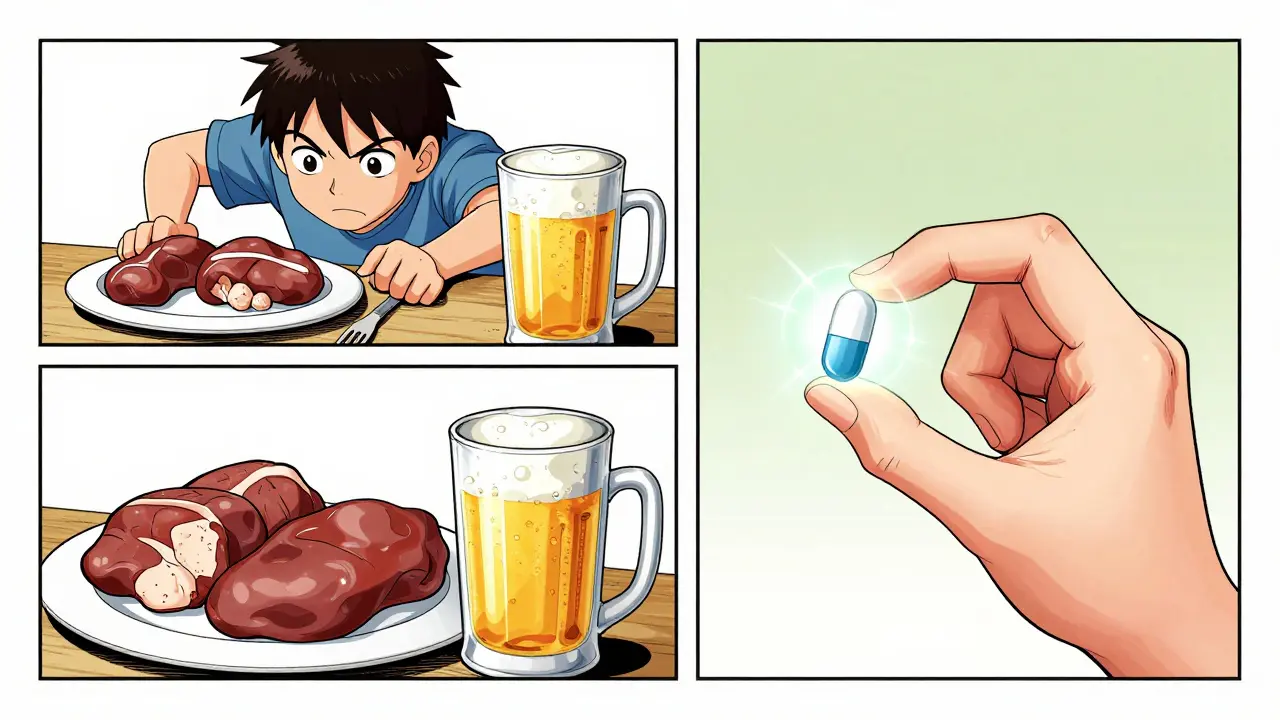
You've probably heard that you should avoid seafood, organ meats, and beer. This is based on the fact that these foods are packed with purines. For example, anchovies and liver are purine bombs. While cutting these out can help, the data shows that diet alone usually only lowers serum urate by 1-2 mg/dL. For someone with a level of 9.0 mg/dL, a diet change won't get them to the target of 6.0 mg/dL.
Think of diet as the supporting cast, not the lead actor. Reducing alcohol-especially beer-and avoiding high-fructose corn syrup can reduce the load on your system, making your medications more effective. But if you're relying solely on a diet to cure chronic gout, you're likely fighting a losing battle against your own genetics.
Looking Ahead: The Future of Gout Treatment
The field is moving toward more personalized medicine. We are seeing the development of selective URAT1 inhibitors like verinurad, which aim to increase uric acid excretion more effectively than older drugs. There is also a growing focus on genetic markers, such as SLC2A9 variants, which can tell a doctor whether a patient is more likely to be an "over-producer" of uric acid or an "under-excreter." This will eventually allow doctors to pick the right drug on day one rather than using a trial-and-error approach.
What is the target uric acid level for someone with gout?
For most people, the goal is to keep serum uric acid levels below 6.0 mg/dL. If you have severe tophaceous gout (visible crystal deposits), your doctor may aim for a tighter target of below 5.0 mg/dL to ensure crystals are actively dissolving.
Can I stop taking allopurinol once my levels are normal?
No. Gout is generally considered a lifelong metabolic condition. Because your body has a genetic or physiological tendency to produce too much uric acid or excrete too little, stopping your medication usually leads to levels climbing back up, which eventually triggers another flare.
Why does my toe hurt more after starting gout medication?
This is often called a "mobilization flare." As the medication lowers the uric acid in your blood, crystals in the joint begin to dissolve. This process releases particles that trigger inflammation. This is why doctors recommend taking low-dose colchicine for several months when starting a new urate-lowering therapy.
Is febuxostat better than allopurinol?
Febuxostat is often more potent and can be more effective at reaching target levels in patients who don't respond to allopurinol. However, it is more expensive and has a black box warning for cardiovascular risks, making allopurinol the preferred first-line choice for most.
Which foods should I absolutely avoid?
The most problematic foods are organ meats (liver, kidneys), certain seafood (anchovies, scallops, sardines), and alcohol, specifically beer and grain spirits. High-fructose corn syrup found in sodas and processed sweets also increases uric acid production.
Next Steps for Management
If you're currently managing gout, your first priority should be a blood test to check your current serum urate levels. If you're on a medication but still having flares, ask your doctor about dose titration-you might simply need a higher dose to hit that 6.0 mg/dL target. For those with severe cases, discuss whether a uricase agent is a viable option given the cost and insurance requirements. Always ensure you're tracking your kidney function (eGFR) via regular blood work, as this determines which medications are safe for you to use.


mimi clouet
April 15, 2026 AT 12:19